Showing posts with label Angelfish. Show all posts

Tuesday, December 28, 2010

Different Cichlid Types You Should Know


There is no question that cichlids are fast becoming one of the most popular pet fishes. This is just understandable given the lovable characteristics of cichlids. If you want to follow the trend, you better acquaint yourself to the different cichlids types. The ones below can be considered as the most popular types of cichlids. Check to see if one of them is the one that you would like to have on your own.
Discus fish
The Discus fish is a common choice because they are very sociable. You see, most cichlid breeds are aggressive and dominant so they are usually hard to incorporate with other fishes. Although discus fishes live in large groups, they are really very fond of schooling. The best tip when taking care of discus fish is to ensure that you get at least three of them. Their fish personality dictates that they be part of a group. Having two or only one cichlid in an aquarium would only make the discus fish sad and lonely.

Angelfish Cichlid
You probably know it as angelfish but this type is very much a part of the cichlid breed. What you should understand is that Angelfish Cichlid is the more obvious choice for people who want fish pets that are relaxed. They are not too aggressive that most people fall in love with their natural grace. Angelfish Cichlids are also very elegant.

Convict Cichlid
These types of cichlids are the most appealing to beginning cichlid owners. You see, Convict Cichlids are very much easy to keep. They also require low maintenance duties. The only downside is that you need to put on effort in decorating its new home. As much as possible, your tank must be very similar to its natural habitat-rocky with caves and substrate. Convict cichlids often burrow themselves so make sure you give them enough space to play around.

Dwarf Cichlid
The Dwarf Cichlid is probably one of the most challenging to keep. However, most breeders prefer them over other cichlid types because they are less aggressive than some of its relatives like the Bolivian cichlids. They are also easy to mix with other fishes as long as they are compatible with each other. Although quite active, dwarf cichlids are very popular among breeders and cichlids enthusiasts.

• Jack Dempsey
Jack Dempsey is obviously named after the well-known boxer. They are loved because of their colors. They usually have greenish pecks in their tan bodies while they are young. They turn to purple gray when they get more mature. Their green specks usually turn to gold during these times.

• Oscar Fish
The Oscar fish is one of the toughest varieties. Their best feature is that they can stand almost any kind of water types. They also grow beyond 18 inches. They also have wide food choices including live food, flakes and pellets. It is easy to know if you aren't feeding Oscar fishes enough. Their colors wouldn't be that bright if they are unhealthy. So, it's the sign to watch out for.

Knowing these cichlid types can really help you jumpstart your hobby as a cichlid collector.

Is your cichlid always sick and unhappy? Are you looking for resources to help care, keep and breed healthy and beautiful cichlids? Larry Pearson is an Expert Author and an authority on caring and breeding cichlid fish.

Tuesday, December 7, 2010

Three Freshwater Aquarium Fish You Need Named A-B


Angelfish

Great in a community tank, it moves around at a slow pace and is lovely to look at with wonderful colors. Adults can be as big as fifteen centimeters long, so think about that when you are working out how many fish your aquarium can accommodate.
Temperature wise they can endure quite a wide range and they are also happy with a variable range of foods.

This fish looks silvery, is thin and has curvy fins that sweep backwards. Distinct vertical stripes run along the body from the caudal fin to the eye. And you can tell when this fish is afraid as these black stripes suddenly fade away.
Other Angel fish such as the black one, obviously don't show these stripes as clearly. Another one, an Angel fish has lace patterns on the fins. Longer fins can be found on another Angel fish, the Veil Angel that has a marble effect.

Sexing these fish is not easy. When you do manage to get a pair they remain loyal to each other and look after they young well. When breeding you will need a well planted tank with broad leaves and the light needs to be at a low level. Sticky eggs are produced within two or three days.
Bear in mind that these fish can eat the eggs, especially if they feel afraid. The young can be fed with infusoria and then micro worms and then brine shrimps.

Badis

You cannot say that this fish has one particular color as there are lots and lots of variations. The colors vary from red to a nearly purple color and spots have even been noted. Not only that, the color changes depending on the aquarium conditions and during breeding.

Major characteristics are a dorsal fin that that might have bluish green stripes, scales with a line around them and a stripe crossing the eye.
When breeding make sure that the male is smaller than the female because she can be injured by a bigger male. As a cave dweller ensure you use something like a plant pot for it to breed in. Have a well planted aquarium with a water temp of twenty nine degrees centigrade. Remove the female after egg laying, wait for them to hatch and then remove the male. Use infusoria to feed the young.

Black Widow

The family is Characidae and the scientific name is Gymnocorymbus ternetzi. This is a popular freshwater aquarium fish as it is peaceful, fairly small at 6.5 centimetres and therefore great in a community tank. Nevertheless it is susceptible to bad water conditions and this can be identified by seeing if it swims with the head down. Food wise, a range of feeding can be used but it prefers live food.

Color wise its body has vertical dark stripes with red circled eyes and a silvery green body. Sexing is difficult a clue is that the male is not as fat in the body and it has bigger frontal and anal fins and dorsal fins that are sharper. The breeding tank must be thickly planted at on end, water at twenty degrees centigrade and you also need floating plants.

After breeding the eggs are dispersed, some adhering themselves to plant leaves and others falling to the bottom. Remove the breeding pair after spawning and you will see the fry after about thre days. Feed the young on infusoria, then brine shrimp.

Sunday, January 3, 2010

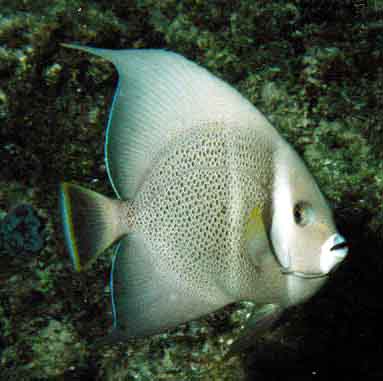
Gray Angelfish


The gray angelfish is a very large member of the family Pomacathidae that hails from the waters of the Caribbean and South America and can be found as far up as Florida. It is very closely related to the French angelfish which also comes from the same habitats. Its scientific name is pomacanthus arcuatus.

In the wild they have been known to reach lengths of up to 24 inches. That is a massive size for an angelfish. As such, only the largest aquariums should be used to house this species. Nothing less than a 150 gallon is needed. But they really do better with something like a 250 gallon or even a 300 gallon aquarium.

Because they are very similar in appearance to the french angelfish, there may be some confusion to the casual onlooker when it comes to differentiating the two species. As juveniles, it is very hard to tell them apart. The one area you should look at is their tail. French angelfish have rounded tails while gray angels have a much straighter tail. As adults, the differences are evident as only the french angelfish has golden flecks across its main body.

They have hearty appetites and need to be well feed in captivity. Feed them a variety to ensure they are given a varied diet. Frozen meaty foods along with seaweed sheets should be offered. Some great pellets brands to offer are those by Ocean Nutrition and New Life Spectrum. There are a variety of pellet formulas so choose something with a good mix of foods.

Overall, this fish can be a hardy addition to the aquarium once acclimated. Also, they are not reef safe and will go to town on your corals.

Monday, February 16, 2009

Large Angelfish


Marine Large Angelfish belong to the Pomacanthidae family, and are classified into seven different genera which include: Pomacanthus, Holacanthus, Pygoplities, Apolemichthys, Euxiphipops, Chaetodontoplus, and Genicanthus. Some Angels in this group undergo drastic color changes from juvenile to adult patterns. Unlike most other Angelfish, some members of genus Genicanthus have distinguishing color differences between males and females. Males are usually larger and more colorful than females of the same species. The largest Pomacanthus Angel reaches a maximum size of over 20 inches in the wild. All Angelfish can be distinguished from their closest relative the Butterflyfish, by the characteristic spine on their lower cheek. This spine is used defensively, but can also be used in aggression.

Angels are found throughout the world, and are most commonly associated with coral reefs. They inhabit lagoons, reef slopes, drop offs, rocky areas, rubble areas, and areas of rich coral formations.

Most members of this group of fish are found in pairs or harems in the wild. A harem consists of one male and several females. Most Angels that form harems in the wild are capable of changing sex. If the male of the harem is eaten by a predator or dies, the dominant female can change sex to become the dominant male. The fish will actually change form, and will also have the ability to successfully spawn with other females. The breeding of Angelfish in an aquarium is extremely difficult. It is advisable not to introduce Angels from the same genus into one aquarium, as fighting will usually occur.

In the wild, the diet of Large Angelfish consists of microalgae, macroalgae, sponges, and zooplankton. Some juvenile Angels in this group act as cleaners when very young, picking parasites and dead tissue from other fish in the wild. In an aquarium, most angelfish should be fed a diet including vegetable matter and meaty items. High-quality angelfish preparations containing sponges are also advised.

They are generally compatible with: Dwarf Angelfish, Anglers & Frogfish, Anthias, Basslets, Batfish, Blennies, Boxfish, Butterflyfish, Clownfish, Damselfish, Eels, Goatfish, Groupers, Grunts & Sweetlips, Hawkfish, Hogfish, Lionfish & Scorpionfish, Parrotfish, Puffers, Squirrelfish, Tangs & Surgeons and Wrasse.

Caution is required with: Cardinalfish, Filefish, Gobies, Pseudochromis, Sharks & Rays and Triggerfish.

They are not compatible with: Large Angelfish and Seahorses & Pipefish.

Dwarf Angelfish


Marine Dwarf Angels or Pygmy Angels belong to the Pomacanthidae family. The majority of these fish are classified in the genus Centropyge, and a few in the genus Paracentropyge. Most Angels in this group reach a size of up to four inches in an aquarium. In the wild, the largest reach an adult size of no more than six inches in length. Dwarf Angels are among the most colorful and most popular of all marine fish. All Angelfish can be distinguished from their closest relative the Butterflyfish, by their characteristic spine on the lower edge of their cheek. This spine is used defensively when the fish is harassed, but it can also be used aggressively. These Angels are found throughout the world and are most commonly associated with coral reefs. They inhabit lagoons, reef slopes, drop offs, rocky areas, rubble areas, and areas of rich coral formations. Most Dwarf Angels are found in pairs, but a few species are solitary and territorial.

Dwarf Angels usually do not mix well together in the average home aquarium unless the tank is larger than 70 gallons. If Dwarf Angels are going to be maintained together, try to vary the sizes of the fish, and add the Dwarf Angelfish to the aquarium simultaneously. This will help prevent one specimen from developing too large a territory and becoming overly aggressive.

As with most species of marine fish, sexual differences are not distinguishable. The Dwarf Angels are hermaphroditic, and the breeding of these fish in an aquarium is extremely difficult.

In the wild, the diet of these fish consists mainly of algae and tunicates. The majority of Dwarf Angels adapt well to life in an aquarium, as long as ample hiding places are provided along with algae for grazing.

They are generally compatible with: Large Angelfish, Anglers & Frogfish, Anthias, Basslets, Batfish, Blennies, Boxfish, Butterflyfish, Cardinalfish, Clownfish, Damselfish, Filefish, Goatfish, Gobies, Grunts & Sweetlips, Hawkfish, Hogfish, Parrotfish, Pseudochromis, Puffers, Squirrelfish and Tangs & Surgeons.

Caution is required with: Dwarf Angelfish, Eels, Groupers, Lionfish & Scorpionfish, Triggerfish and Wrasse.

They are not compatible with: Seahorses & Pipefish and Sharks & Rays.

Wednesday, January 7, 2009

Bala Shark - Good Companions for Angelfish


Common name: Bala shark

Fish name: Balantiocheilos melanopterus

Maximum size (min-max): 30.0 - 40.0 cm ( 11.8 - 15.7 in)

PH of water: 5.8 - 7.9

Water hardness (dGH): dGH 4.0 - 12.0 N

Recommended temperature: 22.0 - 29.0 C ( 71.6 - 84.2 F)

Temperament to its family: peaceful

Temperament to other fish species: peaceful, good companions for angelfish

Place in the aquarium: Middle levels

The way of breeding: Spawning

Fish origin: East Asia

Short description: This fish is also known as Silver shark, Tri Color Shark.

Pleco Fish


Scientific Name : Hypostomus plecostomus
Common Names : Suckerfish, Suckermouth Catfish
Care Level : Easy to moderate
Size : Up to 18 inches (46 cm)
pH : 6.5 - 7.5
Temperature : 73°F - 82°F (23°C - 28°C)
Water Hardness : 5° to 19° dH,
Lifespan : 10 - 15 years
Origin / Habitat : South America
Temperament / Behavior : Generally peaceful, but can be aggressive toward others of the same species. Good companions for angelfish.
Breeding / Mating / Reproduction : It can be very difficult to breed them in a home aquarium.
Tank Size : Depends on the type, but a 55 gallon minimum for the common pleco given its large adult size.
Compatible Tank Mates : Many, given the mostly peaceful nature of this fish.

It is usually referred to as "Pleco" because of the superstition that if you spell it fully or correctly your fish will soon die. The common plecostomus is well known as an algae eater and can often be found stuck to the side of your aquarium. Many will get very large with the common variety getting to be almost 18 inches (46 cm) and will outgrow most aquariums under 55 gallons.

As they get older they may eat algae less often and you will need to supplement their diet with algae wafers that sink to the bottom of your tank. Shrimp pellets that drop to the bottom of the tank are another favorite. Drop in the algae wafers or shrimp pellets after you turn off the lights for the day to prevent the other fish in the tank from getting the food before your pleco can get to it.

There are varieties that don't get as large, such as the Bristlenose Plecostomus which reaches about 5 inches in size as adults.

Tuesday, January 6, 2009

Angelfish Descriptions


Scientific Name : Pterophyllum scalare
Common Names : Albino, Black, Gold, Silver, Marbeled Angelfish, Koi Angelfish, etc - seems there is a common name for each color variety.
Angelfish Care Level : Easy
Size : Up to 6 inches (15 cm)
pH : 6 - 7.5
Temperature : 74°F - 84°F (23°C - 29°C)
Water Hardness : 5° to 13° dH
Lifespan : 8 - 10 years
Origin / Habitat : Amazon River
Temperament / Behavior : Generally peaceful, but can be aggressive eaters and may become territorial while breeding.
Breeding Angelfish / Mating / Reproduction : Use pH of 7.0 and a higher temperature of 80°F. They will lay the eggs on a vertical or diagonal surface. Assuming you have a pair, they are not difficult to breed.


Compatible Tank Mates : Jump to profiles of fish that could potentially be kept with this fish: Pleco, Gourami, Larger Tetras, Bala Shark

The freshwater Angelfish is a very popular tropical fish because of its unique shape and because of their interesting personalities. Angelfish are aggressive eaters and will go to the top of the tank when they see you approach. Because of their aggressive feeding habits, make sure that your less aggressive fish are getting their share around feeding time.

Angel fish are curious about their environment and can become very territorial, especially around breeding time. They will pair off and if any other fish tries to enter their territory they will go after them.


They are not picky eaters. They will go after many types of fish food, including vitamin enriched flakes, frozen, freeze dried and live foods.

They prefer tall tanks over short tanks because of their tall body shape.