Saturday, January 29, 2011

The Effectiveness of Live Rock in Reef Aquariums


Live rock is not just a decoration for reef aquariums but can be an extremely useful addition to saltwater systems. It is collected from the vicinity of a coral reef and consists mostly of aged coral rubble (branches or masses of reef-building coral skeletons) of varying sizes. It varies in quality depending on location from which it was collected. The surface of the rock is often brilliantly colored with calcareous algae, macroalgae, sponges, and even small corals. Burrowing organisms such as worms and crustaceans create a labyrinth of caves and tunnels through the rock, often giving it a very porous nature. On the exterior of the rock and in the open pores where water circulation makes oxygen available, aerobic nitrifying bacteria can be found in large numbers. These bacteria perform the nitrification that is present in virtually any biological filter. An interesting benefit to live rock is that it also harbors live anaerobic denitrifying bacteria in its deep recesses that break down nitrate molecules.

Live rock is an excellent addition to the sump of a central water system. At times I have relied solely upon it to filter the water in my aquarium. It is best, however, to rely on live rock as an enhanced source of natural filtration. The bottom of the sump can be covered with cured live rock that is void of organisms that require high light levels. Room light is usually enough to keep certain algae species alive, but a fluorescent light can improve the growth of these plants and also the nitrification of wastes. Live rock is not without disadvantages. The burrowing organisms within the rock secrete waste and when packed tightly together drastically reduce flow rates through the rock. Over time nitrogenous wastes can build up in crevices of the rock. Weekly or monthly purging of the rock will keep these wastes from becoming harmful.

Live rock should not be added directly to broodstock aquariums, as many demersal spawners will place their eggs on or within the rock. For species such as dottybacks, whose eggs must be removed for hatching, the rock makes this task extremely difficult. Gobies will find the tiniest of holes to spawn in, and removal of the fish or the spawn becomes a daunting task.
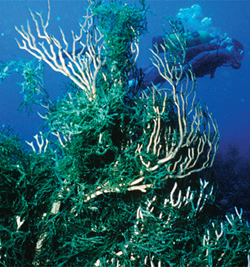
Macroalgae Filters in Saltwater Aquariums


Much debate and alarm have been raised about the destruction of wetlands, mangrove forests, seagrass beds and saltmarshes. These habitats are vital to the survival of coral reefs. Terrestrial waste products leach into ground water where they eventually reach the shoreline. As the water trickles past the roots and leaves of these plants, most of the waste products such as nitrates and phosphates are stripped from the water. This concept can be used to filter aquarium water as well.

Many plant filters have been created for use in freshwater aquariums. There is no single-best design for these filters, but the concept is simple. Plants are to grow either fully submerged in the sump (aquatic species) or propped up so their roots penetrate the water's surface and strip ammonia, nitrogen, phosphates and other toxins from the water. Freshwater tanks are easily filtered with a great variety of plants. Fitting a marine aquarium with a plant filter is more difficult, since relatively few plants can tolerate sea-water. There are a few plant candidates for such filters that may or may not be suited to every marine enthusiast. These filters require a lot of space and may not fit in a small fish room.

These natural filters should not be the sole means of filtration, but are worth the time to set up. The easiest way to benefit from plants is to place a handful of Caulerpa or Chaetomorpha in the sump over some live rock, give it some light and allow it to flourish. These aquatic macroalgaes rapidly if supplied with the right conditions. The faster the plants are allowed to grow, the more waste products they will remove from the water. Frequent pruning will ensure waste removal and facilitate new growth. More elaborate systems can be set up, but simplicity of maintenance is a key issue in selection. Algae turf scrubbers remove ammonia, nitrates and phosphates, but are not easy to acquire and can be difficult to maintain.

Caution should be taken with plant filters as pH and dissolved oxygen levels may be drastically altered by the addition of a mass of photosynthesizing plants. Drastic changes can be prevented with a timer to light plants only at night or when the aquariums are unlit.

Top 7 Aggressive Cichlids Commonly Known


With the large number of cichlid breeds, it is just natural that there would be a few that will stand out. In the aggressive category, there are those that one would find to be more challenging to take care of. Aggressive cichlids are sometimes hard to handle especially for beginners. However, cichlids enthusiasts are also interested in them probably because of the challenge they pose.

According to cichlid forums, the aggressiveness of particular cichlid species might differ in given scenarios. But to give you an overview, here are some of the cichlid breeds that are considered to be the kings of their tanks.

1. Nandopsis beani
Nandopsis beani has consistently been included in the most aggressive cichlids lists by expert keepers. There are a lot of comments that these cichlids are really one of the toughest of them all. Most experts are also one with saying that they should not be mixed with other fish species.

2. Telmatochromis Dhonti
Other than its 6-inch size, the Telmatochromis Dhonti is also making waves when it comes to the aggressive department. This particular cichlid specie is said to have strong jaws that makes it easy for them to tear down its opponent. It's also a bad idea mixing them with other aggressive cichlids unless you want to see them squabble.

3. Neolamprologus Christyi There have been a lot of remarks regarding Neolamprologus Christyi. Everything seem to point out that this cichlid specie is not something to mess up with. Size does matter with this 7-inch bully as it can really pick on other smaller fishes. Neolamprologus Christyi can also take on the equally competitive Telmatochromis Dhonti.

4. Tilapia buttikofferi
Tilapia buttikofferi may be underrated because it takes an expert to know that they are really aggressive. Some see this cichlid breed as easier to handle because their competitiveness subside when they are placed in a large tank. However, most enthusiasts agree that it won't be a good idea to put them with other aggressive fishes since they aren't tolerant of bullying.

5. Amphilophus festae
This cichlid type is known for its nasty temper. They are believed to be milder than their relative like Nandopsis haitiensis but they aren't too friendly either. Their temper becomes more challenging to handle when they reach their mature phase.

6. Amphilophus labiatus
This cichlid specie has earned the respect of most cichlids keepers. Common comments center on it being nasty and short-tempered. These cichlids would require a lot of attention especially if you plan on mixing them with other tank-dwellers who are not as aggressive.

7. Crenicichla strigata
It might be vicious to have this cichlid type in your tank if you have other fishes around. Crenicichla strigata has the power to kill its competitor with great ease. Its natural domineering qualities would have your other fishes bidding goodbye one by one.

Fish keepers should respect that cichlids have their own personalities too. There might be general information about them but it is still best to observe their attitude closely. After all, your pets very well deserve your attention.

How to Keep Your Koi Fish Pond Clear


One of the most asked questions I get from people who own Koi ponds, is "how to you keep your Koi pond so clear"? The very first thing that I ask them is how many fish do you have in your pond and how what is the size of your pond. Keeping a pond clear is really a many step process. I have listed a few suggestions below.

First you must keep your fish waste to a minimum using the rule of thumb that one 12 inch Koi per 100 gallons of water. Most people always have more fish than their pond can handle waste. The only other way that you can alleviate this problem is to make sure your pond has a bottom drain system. This means your pump is outside of the pond. A good bottom drain system will increase the flow of water which will cycle your water more per hour.

Another important part of the pond system is your filtration. Without good filtration the waste you pick up by your pump can end up right back in your pond. I am an advocate of bigger is better, and that is also true for your pond. Next time you visit your local pond store look at the pond filters; you will see 500, 750, 1000, meaning gallons of water they can handle. Why not purchase a pond filtration system that will handle 500 gallons more than the water in your pond. However, you always want to match your pump to the filter system you buy.

Now I am going to let you in on a little secret. I use a multi-stage filtration system and in the second to last stage I use lava rock. Lava rock is great for filtering out very small particles that may get by your mesh filters, thus making your pond even clearer! But, that is not my secret; my real secret is alfalfa. If you place a tightly woven amount of alfalfa into your Koi pond, you will be amazed of how it reacts to break down waste. I even have a small ball of alfalfa in my filter box.

Using these few ideas above you should be able to maintain a wonderful environment for your Koi fish. Now you know how to keep your Koi pond clean with healthy fish that you can enjoy for many years to come. This is how I learned about pond maintenance from other people who also want to enjoy their garden pond. Feel free to explore my other resources at my website listed below.

What To Consider When Buying a 100 Gallon Aquarium


When planning to buy a 100 gallon aquarium tank, whether you are keeping one just for fun, appearance, or for commercial reasons, you need to be sure to understand how to maintain it. Appropriate maintenance of a 100 gallon aquarium will guarantee a healthy surrounding for the pet fish and live rock to live in it. Before making the decision to buy a 100 gallon aquarium, here are various points that need to be kept in mind:

When you look online, there are lots of different sorts of 100 gallon aquarium tanks to choose from. Not only do they appear in a wide range of prices, but they're not manufactured from only glass nowadays.

The Construction

The more old fashioned types of 100 gallon tanks is going to have a metal framework which helps to to keep the sheets of glass that help to make the fish tank bond together. Usually, the metal structural part for these sorts of tanks are composed of either of angle steel or chrome steel, which are glued together at the corners of the frame and the glass will then position into it. As a way to prevent water from seeping out of the aquarium fish tank, a putty aquarium tank substance is used around the 4 corners of the glass and the metal construction. Even so, if these aquariums are not set on a even spot then the shape can begin to contract and might end up in the glass shattering. Occasionally the construction of a 100 gallon aquarium tank can be manufactured from wood, and generally plywood is chosen because it is less likely to burst apart if it interacts water.

Resources Used Today

Nowadays, most 100 gallon fish tanks are being constructed from acrylic substance. Most of these tanks built from this material may cost more in a few situations depending on other suppliers, but they weigh less than glass constructed aquariums and are less likely to break.