Showing posts with label Aquarium Algae. Show all posts

Saturday, January 29, 2011

Macroalgae Filters in Saltwater Aquariums


Much debate and alarm have been raised about the destruction of wetlands, mangrove forests, seagrass beds and saltmarshes. These habitats are vital to the survival of coral reefs. Terrestrial waste products leach into ground water where they eventually reach the shoreline. As the water trickles past the roots and leaves of these plants, most of the waste products such as nitrates and phosphates are stripped from the water. This concept can be used to filter aquarium water as well.

Many plant filters have been created for use in freshwater aquariums. There is no single-best design for these filters, but the concept is simple. Plants are to grow either fully submerged in the sump (aquatic species) or propped up so their roots penetrate the water's surface and strip ammonia, nitrogen, phosphates and other toxins from the water. Freshwater tanks are easily filtered with a great variety of plants. Fitting a marine aquarium with a plant filter is more difficult, since relatively few plants can tolerate sea-water. There are a few plant candidates for such filters that may or may not be suited to every marine enthusiast. These filters require a lot of space and may not fit in a small fish room.

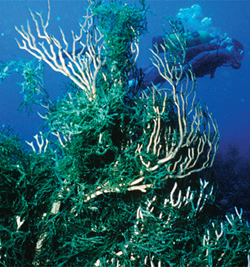
These natural filters should not be the sole means of filtration, but are worth the time to set up. The easiest way to benefit from plants is to place a handful of Caulerpa or Chaetomorpha in the sump over some live rock, give it some light and allow it to flourish. These aquatic macroalgaes rapidly if supplied with the right conditions. The faster the plants are allowed to grow, the more waste products they will remove from the water. Frequent pruning will ensure waste removal and facilitate new growth. More elaborate systems can be set up, but simplicity of maintenance is a key issue in selection. Algae turf scrubbers remove ammonia, nitrates and phosphates, but are not easy to acquire and can be difficult to maintain.

Caution should be taken with plant filters as pH and dissolved oxygen levels may be drastically altered by the addition of a mass of photosynthesizing plants. Drastic changes can be prevented with a timer to light plants only at night or when the aquariums are unlit.

Tuesday, December 28, 2010

The Best Freshwater Aquarium: Glass Vs Acrylic


Many people who are getting started in aquarium keeping will be faced with this question, and it can be quite confusing. It's not easy to decide between acrylic and glass for the best freshwater aquarium without knowing the pros and cons of each, so in this article we will have a look at why you may opt for one instead of the other.

Let's start with glass, the age-old material that has been used for many years to make all sorts of things. It is so trusted because it has its advantages, but it also has its disadvantages.

To start with, glass is much heavier than acrylic. When you consider which is the best freshwater aquarium, you will find that acrylic is the better option. It is much lighter and as a result, even the stand that you use will not be unduly strained. If you think about the possibility of an accident, you are much better off with acrylic too - it will not shatter into tiny, dangerous fragments if it ever falls down. True, the glass aquarium that you buy may be made of toughened glass and therefore hard to break, but this does not mean that it's unbreakable.

Acrylic, though much lighter, is a much tougher material. The material strands are blended in such a way that they can take a lot of strain without giving way and this is what makes it shatter-proof. Glass on the other hand will worry you if it gets even a tiny crack, because it will put strain on the entire structure especially considering that there is the weight of water to make the pressure that much more. As an aside, if you own a glass aquarium and it has a crack, consider replacing it because that is an accident waiting to happen.

Acrylic will also give you options with shape because it is mouldable without making it weaker. Glass is too, but the more you bend and play around with glass, the more delicate and brittle it tends to become. With acrylic, you will be able to get tanks in many different shapes, and you can choose the best freshwater aquarium that is something other than just square or rectangular.

If you ever need to modify your tank, maybe to put in an overflow system, go with acrylic. You can cut it easily with common tools that you can get at your tool store. Glass would require a glass expert and any holes will tend to leave the entire structure rather unstable.

Glass, because of its nature will tend to distort images and light. This means that depending on the angle from which you are looking into your fish tank, you may see that the fish and whatever else is in the tank look distorted. This will not happen with acrylic. Glass tanks also tend to be that much thicker, another factor that will distort view.

Glass does have its positive attributes though; it's a natural material and it will not discolour like acrylic. Acrylic tends to yellow with time, and because your fish tank has algae in it, if you are not very regular with the cleaning, you may find that the color of the tank has permanently changed. Glass will also outshine acrylic any day - you just can't get the same gleam however much you polish an acrylic tank. With an acrylic freshwater aquarium, you are always watching out not to scratch it - scratches are unsightly and they will affect the general attractive look of the tank.

Acrylic, because of all these qualities, will be more expensive, as well as more tasking to ship - it has to be wrapped very carefully so as not to get scratched. All that said though, you are much better off with acrylic as the best freshwater aquarium, so long as you clean it regularly enough for it not to yellow fast and avoid getting scratches on it.
Friday, October 2, 2009

The Truth Why Algae Eaters Are Great Fresh Water Aquarium Fish


Algae eaters are an outstanding add-on to any aquarium but its best to wisely or you may regret your decision to introduce them to fresh water aquarium.

Algae eaters are used to help control algae. They are great fish to clean up the bits and pieces of algae that are inevitable. Algae is a typical product of fish keeping usually caused by build up of nitrates in water. However prevention is a key when it comes to controlling algae.

To cease algae progress you need a strategy to preclude instead of treat algae. You are unlikely to ever be without algae altogether, what you are shooting to do is maintain it at a satisfactory level. Plants inside your fish tank will consume nitrates allowing little for algae to feed upon.

Algae eating fish will help to deal with the rest. So which ones are best and which ones come with a health warning.

Depending upon the size of your aquarium, the planting and the fish that you already have, some algae eaters will be best suitable to your fish tank than others. So once you have decided on what types of algae eaters you will buy, you might want to think about adding some snails or shrimp to deal with other types of algae.

The Siamese Algae eaters are capable of growing up to about five inches in length and ideally they need to be kept in pairs which require them to be held open in a aquarium that is a minimum of about twenty five gallons. They will fit better with most aquariums and eat on brush algae off plants without eating up the plants. They do however have a healthy appetite and are not crabby eaters, tidying the tank of any food that finds its way to the bottom.


Monday, January 5, 2009

Wondering How to Stop Algae in a Saltwater Tank - These Simple Tips Will Help Stop Aquarium Algae


Many aquarium keepers wonder how to stop algae in a saltwater tank and have tried unsuccessfully even after spending large sums of money in the process. This article will help you understand why aquarium algae grows and what you can do to get rid of it in you marine aquarium for the least amount of money possible.

First Why Does Algae Grow In an Aquarium
Algae growth is a natural part of any marine environment. When the algae grows it is using compounds that are harmful to fish and other delicate animals in your tank or the ocean. It basically acts as a line of defense and its growth tells you that there is something out of whack in your tank.

What Makes It Grow In My Saltwater Tank
The biggest contributors to algae growth are nitrates and phosphates and these come from various sources. Uneaten and decaying fish food is a major aquarium algae food source as is fish waste.

Having to many fish in a tank is a common problem that leads to algae growth be cause there is to much waste for the system to handle and the excess fish drive oxygen levels and PH down. Low oxygen will also trigger algae growth and the algae will be fueled by the carbon dioxide.

What Can I Do To Stop The Algae Growth
First you must examine your system and see if it is overstocked, if it is you have to remove enough fish to bring the system back into balance. Every saltwater tank is different but as a good rule one smaller fish per 10 gallons is a good starting pint.

You must also reduce the amount of food you put into the tank and make sure that your fish eat all of it. The easiest way to accomplish this is to feed a few times a day and shut all the pumps off when your add the food, this will give the fish the best chances of eating all the food.

You should also increase the maintenance of your saltwater tank by cleaning all your equipment and filters more frequently. Also start using purified water like reverse osmosis or deionized in place of impurity filled tap water.

Re examine your equipment and make sure that your protein skimmers and filter units are functioning properly and are the adequate size for your system and the fish load of your tank.