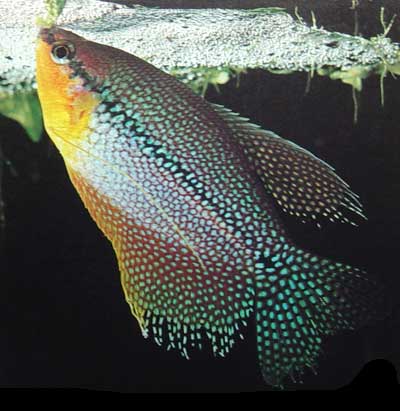
The pearl gourami or Trichogaster leeri is a member of the family Belontiidae. Pearl Gouramis inhabit the lowland swap waters of Sumatra, Borneo, Malaysia and Thailand.
All gouramis belong to the suborder Anabantid. The members of this suborder evolved in poorly oxygenated environments. They subsequently developed an auxiliary breathing apparatus in addition to their gills. This lung-like organ, the labyrinth organ, allows them to breathe atmospheric oxygen. At some point in the evolutionary process they became dependent on both as a means of survival. They will die without a combination of dissolved and airborne oxygen. This is why they are frequently seen at the water's surface.
Unlike the paradise fish, the pearl gourami is a timid creature. They are good additions to a community tank if they are provided with plants, rocks and aquarium décor in which to hide. There optimum water condition is a neutral pH with a water temperature around 78 °F.
Pearl gouramis reach a length of approximately 5 inches and have a life expectancy of 5 years.
They are omnivorous. But they tend to function better on a balanced variety of tropical fish flakes and protein whether freeze-dried, frozen or live.
This species is sexually dimorphic, meaning each sex possesses traits specific to their gender such as size and coloration. Males are typically larger and more colorful than females. The males also exhibit an orange tinge to their fins with the exception of the tail fin. Males have a bright orange region around their throat area. This distinctive coloring is not present in juveniles. It develops as the fish reaches sexual maturity. The color intensifies prior to spawning and is used to attract the female of the species.
Breeding Gouramis
Gouramis have a natural inclination to pair up. Gouramis spawn in still water in their natural habitat. Turn the filter capacity in your breeding tank down prior to spawning. The color of the male's throat region will indicate that he is ready to spawn. A sponge filter works well to simulate mating conditions. And you have the added bonus of not having to worry about the fry getting sucked up into the filter.
Provide plants for the breeding tank. The male will use his labyrinth to build a bubble nest on the water's surface. He will use some of the provided plant matter to help the nest stay together.
Gouramis instinctively spawn underneath the bubble nest. Once fertilization occurs, the male gourami will gather up the eggs with his mouth and spit them into the bubble nest to mature.
Remove the female gourami from the breeding tank after they have spawned. It is the male's job to tend to the nest. He will guard and care for the eggs until they hatch. You will find the male a very attentive custodian of his future offspring.
The fry will hatch in approximately 24 hours. They will be free swimming in 2-3 days. It is now time to remove the male to insure that he does not eat the fry. Once free swimming, the fry can be fed infusoria, or rotifers. When they get about a week old feed them powdered fry food, or newly hatched brine shrimp. An economical alternative is powdered eggs. Make sure not to over feed the fry or you will foul up the water in your tank.
Showing posts with label Pearl. Show all posts
Tuesday, November 17, 2009
Tips on Pearl Danio Care and Spawning
Pearl danio or Brachydanio albolineatus are members of the family Cyprinidae. Other members of this family include tiger barbs, koi, goldfish and freshwater sharks. Pearl danios are native to Sumatra, Burma and Thailand. They inhabit clear watered rivers and hill streams.
Pearl Danio received their name because of their iridescent bodies. They shimmer like a pearl, especially under bright aquarium light. They come in various colors including pink, silver, brownish-yellow and striped. There is also a variety marketed as golden danio. These are actually semi-albinos.
Danios are peaceful, schooling fish that make for good community fish. It should be explained that schooling fish are a type of shoaling fish. Shoaling fish live in a community with other members of their species. Schooling fish not only ban together but also swim in the same direction. In either case, you should add a minimum of four to your fish tank. Social fish were not intended to live a solitary existence. Danios swim at all levels of the aquarium.
Pearls are an extremely hardy fish. They would make the perfect choice for a beginning aquarist. Because they are schooling fish and should be kept in a group, a minimum tank size of 20 gallons is recommended if you intend to have a community tank. If you plan having a mono-species tank can get away with a smaller aquarium. In their natural habitat they are accustomed to the moving water of streams and rivers. A high capacity filter will mimic this movement adequately. And on a final note: Pearls are jumpers. They should only be kept in a lidded aquarium. Follow these rules as a newbie aquarium owner and you are sure to have healthy, happy fish.
These fish are native to tropical climates and thrive in neutral water. Acceptable pH levels are 6.8-7.2. Water temperature should range from 68-78 °F. They will grow to 2.5 inches in length and have an average life span of 5 years but have been reported to live as long as 10.
Pearls are omnivorous. They can survive just fine on common variety tropical fish flakes.
Male and females are similar in appearance. Males tend to be a little more colorful and female bodies slightly more rounded. Body fullness is accentuated if the female is carrying eggs.
Breeding Pearl Danio
If you wish to spawn danios and are unable to sex the, place the entire group in a breeding tank with an abundance of fine-leafed plants.
Danios are egg layers. They scatter their eggs. Most egg-scatterers will eat their own eggs if given a chance. The purpose of the plants is to capture the eggs. Another handy trick is to put a layer of marbles on the bottom of the breeding tank. The eggs that are not captured by the plants will sink down to the bottom falling between the marbles. This will prevent the adults from getting to them. Once spawning is complete, the adults should be removed from the tank.
Fry will hatch in 36-40 hours. After they become free swimming they can be fed infusoria or liquid fry food. There are both liquid and powdered fry foods formulated specifically for egg layers. In about a week change their diet to newly hatched brine shrimp, powdered fry food, or powdered eggs.
Tuesday, January 6, 2009
Pearl Gourami - Isn't They Beautiful?
Scientific Name : Trichogaster leeri
Common Name : Lace Gourami, Diamond Gourami, Leeri Gourami, Platinum Gourami, Mosaic Gourami
Care Level : Easy and hardy, good for freshwaters beginners
Size : 5 inches (13 cm)
pH : 6 - 8
Temperature : 77°F - 82°F (25°C - 28°C)
Water Hardness : 5° to 15° dH,
Life span : 3 - 4 years and longer
Origin / Habitat : Asia, Thailand, Indonesia
Temperament / Behavior : Mostly peaceful but they may scrap with other gouramis. Males seem to be more aggressive than females.
Breeding / Mating / Reproduction :
This fish is a bubble nest builder. Increase the tank water to around 82°F (28°C), lower the water level a little and condition them with good foods (live foods and/or brine shrimp) for a couple of weeks. The male will build a bubble nest and then he will try to get the female to come over to his nest where he will wrap himself around her and she will release the fertilized eggs into the nest. He will then guard the nest. The eggs should hatch within a day or two and the fry should be swimming about 5 days later. Make sure you have fry foods ready - liquid fry food works well. You will want to move them to a grow out tank where you can perform frequent (daily) partial water changes.
Tank Size : 10 gallon minimum if kept singly.
Compatible Tank Mates : They seem to be peaceful most of the time, except for when the male pearls go after each other. Watch for signs of aggression and remove or separate as needed. They may also bicker with other gouramis.
Pearl Danio Fish
Scientific Name: Danio albolineatus
Family: Cyprinidae
Origin: Burma, Sumatra, Thailand
Adult Size: 2 inches (6 cm)
Social: Peaceful schooling fish
Lifespan: 5 years
Tank Level: All levels
Minimum Tank Size: 20 gallon
Diet: Omnivore, eats most foods
Breeding: Egglayer
Care: Easy
pH: 6.5 - 7.0
Hardness: 5-12 dGH
Temperature: 64-74 F (18-24 C)
Description:
If you’ve seen a Pearl Danio you know the iridescent colors it’s named for make it one of the most attractive freshwater fish. Its pearly blue-violet hued body is accented by an orange-red stripe running from tail to mid-body. Males are smaller, slimmer, and more colorful, often showing a red tint along the ventral aspect. A yellow ochre color variant, known as the 'Yellow Danio', is available in some locations.
Pearl Danios have a forked tail, paired barbels, and reach a maximum length of two inches (6 cm). They are live for approximately five years. An extremely hardy and easy to care for fish, Pearls make an excellent beginner fish. They are peaceful, and well suited to community tanks with other small to medium sized fish. Like others of the Danio family, Pearls live in schools and should always be kept in groups of four or more.
Subscribe to:
Posts (Atom)