Showing posts with label Gouramis. Show all posts

Tuesday, November 17, 2009

Tips on Pearl Gourami Care and Spawning


The pearl gourami or Trichogaster leeri is a member of the family Belontiidae. Pearl Gouramis inhabit the lowland swap waters of Sumatra, Borneo, Malaysia and Thailand.

All gouramis belong to the suborder Anabantid. The members of this suborder evolved in poorly oxygenated environments. They subsequently developed an auxiliary breathing apparatus in addition to their gills. This lung-like organ, the labyrinth organ, allows them to breathe atmospheric oxygen. At some point in the evolutionary process they became dependent on both as a means of survival. They will die without a combination of dissolved and airborne oxygen. This is why they are frequently seen at the water's surface.

Unlike the paradise fish, the pearl gourami is a timid creature. They are good additions to a community tank if they are provided with plants, rocks and aquarium décor in which to hide. There optimum water condition is a neutral pH with a water temperature around 78 °F.

Pearl gouramis reach a length of approximately 5 inches and have a life expectancy of 5 years.

They are omnivorous. But they tend to function better on a balanced variety of tropical fish flakes and protein whether freeze-dried, frozen or live.

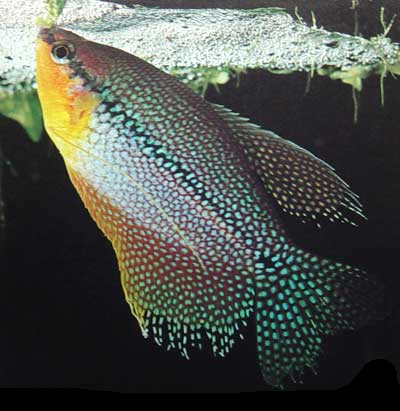
This species is sexually dimorphic, meaning each sex possesses traits specific to their gender such as size and coloration. Males are typically larger and more colorful than females. The males also exhibit an orange tinge to their fins with the exception of the tail fin. Males have a bright orange region around their throat area. This distinctive coloring is not present in juveniles. It develops as the fish reaches sexual maturity. The color intensifies prior to spawning and is used to attract the female of the species.

Breeding Gouramis

Gouramis have a natural inclination to pair up. Gouramis spawn in still water in their natural habitat. Turn the filter capacity in your breeding tank down prior to spawning. The color of the male's throat region will indicate that he is ready to spawn. A sponge filter works well to simulate mating conditions. And you have the added bonus of not having to worry about the fry getting sucked up into the filter.

Provide plants for the breeding tank. The male will use his labyrinth to build a bubble nest on the water's surface. He will use some of the provided plant matter to help the nest stay together.

Gouramis instinctively spawn underneath the bubble nest. Once fertilization occurs, the male gourami will gather up the eggs with his mouth and spit them into the bubble nest to mature.

Remove the female gourami from the breeding tank after they have spawned. It is the male's job to tend to the nest. He will guard and care for the eggs until they hatch. You will find the male a very attentive custodian of his future offspring.

The fry will hatch in approximately 24 hours. They will be free swimming in 2-3 days. It is now time to remove the male to insure that he does not eat the fry. Once free swimming, the fry can be fed infusoria, or rotifers. When they get about a week old feed them powdered fry food, or newly hatched brine shrimp. An economical alternative is powdered eggs. Make sure not to over feed the fry or you will foul up the water in your tank.

Sunday, March 15, 2009

The Popular Kissing Gourami


The Kissing Gourami gets its' name due to the behavior between two males attempting to show their dominance. They appear to be kissing, but actually they are challenging one another. The male also does the "kissing" act with the female before spawning. Call it what you wish; it's amusing to see.

The green colored Kissing Gouramis have a dark bar bordering the dorsal and anal fins. The pink or flesh toned fish have silvery scales. Their bodies are oval shaped and they have thick fleshy lips, with rows of fine teeth in their mouths, which is great for chewing down plants to the stem. Because of those teeth, you will need to have plastic plants or sturdy Java fern in their tank.

They need plenty of room, as they grow to six inches or more in length. An aquarium of at least 45- gallon is advisable. They are not particular about most water conditions, but thrive best in temperatures of 75 - 82 degrees.

Kissing Gouramis can become quite quarrelsome and most of them are masters at bullying. Watch for signs of aggression, especially with other species. They should only be housed with other medium to large sized breeds and even then watch them for signs of showing others who's boss.

These fish have big appetites and enjoy flaked foods, Tubifex and brine shrimp .For optimum health, offer them fresh Romaine lettuce and cooked peas. Kissing Gouramis are also big algae eaters. Driftwood in the aquarium is a good idea, as this provides them with much algae. They will also suck off algae on the sides of the tank and pebbles.

It is near impossible to differentiate between the two sexes. You will finally know you have a male and female when you see that some "kissing" is going on along with circling and nudging. This means spawning has begun. Next, the male wraps his body around the female. She releases several hundreds of eggs which is then fertilized by the male. If there is a large leaf of Romaine lettuce floating on the surface of the water, the eggs will adhere to them after floating upwards.

Naturally, many of these eggs will be eaten, but some "dads" will become protective and keep a close eye on these eggs, chasing away fish that get too close. The eggs will hatch approximately in one day. And two days later you will have many free swimmers. Now is the time to remove the fry to another tank.

The best way to feed the tiny fry is to press a cooked egg through a cheesecloth. As they become larger and they can fit flaked food into their mouths, you can begin weaning them from the egg. Feed them baby brine shrimp too.

Kissing Gouramis are easy fish to maintain in the aquarium. As long as they are provided with a good diet and plenty of room to grow and swim, you can expect these hardy fish to live approximately 5 years.

Wednesday, January 7, 2009

Paradise Gourami - Paradise of Fish


Endowed with a rich and brilliant color pattern, the Paradise Fish, one kind of Gourami, is among the most glamorous in the freshwater fish hobby. They are quite hardy and of a good size. They are also surprisingly intelligent and curious, and make a very personable attractive aquarium inhabitant. Paradise Fish are a joy to keep if appropriate research and planning goes into their aquarium set-up, tank mates, and care.

When picking out a Paradise fish, be sure to choose your stock carefully. A desire to breed these fish in the brightest coloration and to provide them in large quantities, has unfortunately led to a mass production of fish that are neither colorful nor healthy. The Paradise Fish you pick should be alert and enjoying moving about, a lethargic fish is not healthy and is unlikely to “recover”.

Thicklip Gourami


The Thicklip Gourami in its natural coloration is becoming a rarer and rarer sight, which is a shame. Much of its popularity has been lost to the Dwarf Gourami, because few hobbyists have the patience for the Thicklip Gourami's full colors, which are slower in coming. Those which do commit to the Thicklip Gourami are heavily rewarded when males flush with breeding colors which are some of the most brilliant of the family.

Furthermore, the development of new color variants brings more consistency in terms of color. Although this new generation's color still has nothing on the old wild colors of this fish, sales of the variants are skyrocketing and their arrival seems to have sealed the fate of the wild coloration of the Thicklip Gourami.

Chocolate Gourami


Family: Belontiidae
Range: Sumatra, Borneo, Malay Peninsula, Malacca
Size: Up to 1¾ inches
Diet: Omnivore
Tank Set-up: Freshwater: Plants
Tank Conditions: 75-86°F; pH 6.0-7.0; dH 2-4
Minimum Tank Capacity: 30 gallons
Light: Medium
Temperament: Peaceful
Swimming Level: Middle to bottom
Care Level: Difficult
Reproduction: Mouth Brooder

The Chocolate Gourami is a peaceful fish that is greenish-brown with pearly-yellow stripes running vertically along its body. There is a dark, almost black 'spot' bordered in yellow at the base of the tail. This gourami makes a rewarding challenge for the advanced hobbyist, especially in breeding pairs. Chocolate Gouramis are considered labyrinth fish, meaning that although they are equipped with gills, they also have a special organ which allows them to also breathe directly from the air. As a result, they must have access to the surface of the water in the aquarium.

The Chocolate Gourami is a delicate fish that should be housed in at least a 30-gallon tank. It can be prone to bacteria and skin parasites, so good water quality is essential. The Chocolate Gourami prefers a well-established, thickly planted tank, with peat extract. Frequent water changes are a must. It does best if kept in pairs and is compatible with other shy, peaceful fish as tank mates.

The best way to differentiate between the male and female is the yellow border that extends along the edge of the male's anal and caudal fins. The Chocolate Gourami is a mouth brooder and a frugal spawner. The male and female will spawn on the bottom of the tank and the female collects the eggs in her mouth. She will hold the eggs for 14 days during which time she does not eat, therefore, it is important that the female be in top condition before breeding.

The Chocolate Gourami is an omnivore and prefers both algae-based foods as well as meaty foods. An algae-based flake food, along with freeze-dried bloodworms, tubifex, and brine shrimp will provide this fish with the proper nutrition.

Kissing Gourami - How Sweet They are


  • Scientific Name: Helostoma temminckii
  • Family: Helostomatidae
  • Origin: Java, Thailand
  • Adult Size: 6-12 inches (15-30 cm)
  • Social: Generally peaceful
  • Lifespan: 5 years
  • Tank Level: Top, Mid dweller
  • Minimum Tank Size: 30 gallon
  • Diet: Omnivore, eats most foods
  • Breeding: Egglayer
  • Care: Intermediate
  • pH: 6.8 - 8.5
  • Hardenss: 5 - 30 dGH
  • Temperature: 72-82 F (22-28 C)

Description:

The popular Kissing Gourami, or ‘Kisser’, originates from Thailand, where it is cultivated as a food fish. These days virtually all specimens sold in the USA are commercially bred in Florida. Two colors of this fish occur naturally; a pink or flesh colored form, and a silver-green form often referred to as the Green Kisser.In the past these were believed to be the same species, but they have since been reclassified as two separate species. The green species, which has a dark bar bordering the dorsal and anal fins, is Helostoma temminckii, the name previously associated with the popular pink variety. The traditional pink Kissing Gourami is now classified as Helostoma rudolfi.Their common name is derived from what appears to be kissing; however scientists still aren’t sure of the true purpose of the behavior. It’s believed to be a harmless challenging behavior, which generally occurs between two males. This conjecture is supported by the fact that aging seems to diminish the need to challenge one other. With age comes wisdom, or at least the ability to peacefully cohabit with others.Both sexes of Kissing Gourami look almost identical; from their oval shape to their thick fleshy lips. What you can’t see are the rows of fine teeth on the inside surface of those lips, which are used to graze on algae and vegetable matter. Another unseen structure in these fish is the labyrinth organ, which is present in all labyrinth fishes.This organ enables them to take oxygen from the air, thus permitting them to survive in waters with low oxygen levels. In fact, the gills of labyrinth fishes are usually not capable of obtaining enough oxygen from the water to survive. Therefore, they must satisfy some of their oxygen requirement by gulping air at the surface of the water. That is why it is essential to provide them with access to the water surface.

Tuesday, January 6, 2009

Moonlight Gourami


Scientific Name: Trichogaster microlepis

Common Name: Moonlight Gourami

Family: Belontiidae

Origin: Thailand, Cambodia

Adult Size: 6 inches (15 cm)

Social: Peaceful, suitable for community tank

Lifespan: 4 years

Tank Level: Top, Mid dweller

Minimum Tank Size: 20 gallon

Diet: Omnivore, eats most foods

Breeding: Egglayer - bubblenest

Care: Intermediate

pH: 6.0 - 7.0

Hardenss: 2-25 dGH

Temperature: 79-86 F (26-30 C)

Description:

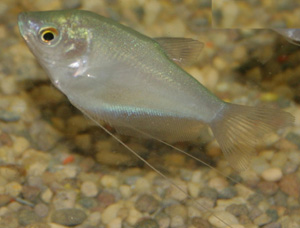
The common name describes this peaceful labyrinth fish quite well. It's body is silvery colored with a slightly greenish hue that is not unlike the soft glow of moonlight. The concave slope of the head in the Moonlight Gourami distinguishes it from other Gourami species.

Dwarf Gourami - Are they really dwarf?


Scientific Name: Colisa lalia

Other Names: Powder Blue Gourami, Red Gourami

Family: Belontiidae

Origin: Ganges, Jumna, Bramaputra

Adult Size: 2 inches (5 cm)

Social: Peaceful

Lifespan: 4 years

Tank Level: Top, Mid dweller

Minimum Tank Size: 5 gallon

Diet: Omnivore, eats algae

Breeding: Egglayer - bubblenest

Care: Intermediate

pH: 6.0 - 7.5

Hardness: 4-10 dGH

Temperature: 72-82 F (22-28 C)


Description:

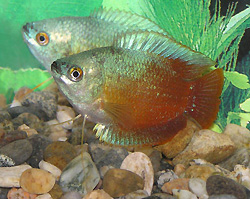
The common name fits this fish well, as it grows to a size of only two inches. Males are slightly larger than the females and have a bright orange-red body with turquoise blue vertical stripes that extend into the fins. The dorsal fin of the male is pointed in contrast to the rounded dorsal of the female. Females remain a duller silvery blue-gray color, never achieving the brilling colors of the male. Several color hybrids exist, including Blue/Powder Blue), Neon, Rainbow, and Red/Blushing.Powder Blues are predominately blue with only a little red showing on the body. Neons display a brighter blue pattern than the standard variety. Rainbows have especially brilliant orange-red bodies and blue stripes, in addition to a green-gold metallic sheen. Reds are almost solid red throughout the body, with solid blue dorsal fins

Blue Gourami

Scientific Name : Trichogaster trichopterus
Common Names : Three Spot Gourami, Opaline Gourami
Care Level : Easy
Size : Up to 6 inches (15 cm)
pH : 6 - 8
Temperature : 74°F - 82°F (23°C - 28°C)
Lifespan : 5 years or longer
Origin / Habitat : Southeast Asia
Temperament / Behavior : May be aggressive with males of the same species and with females of the same species after spawning. They may become skittish with larger tank mates.
Blue Gourami Breeding / Mating / Reproduction :

They have been bred in captivity and are egg layers. Breeding behavior is similar to the Betta Splendens. Males build a bubble nest and try to initiate spawning. Females should be removed after spawning and the male will tend to the eggs until they hatch.

Tank Size : 20 gallon minimum

Compatible Tank Mates : They can be relatively peaceful if kept with similar sized and larger tank mates. You may have issues when keeping them with other males.

Pearl Gourami - Isn't They Beautiful?

Scientific Name : Trichogaster leeri
Common Name : Lace Gourami, Diamond Gourami, Leeri Gourami, Platinum Gourami, Mosaic Gourami
Care Level : Easy and hardy, good for freshwaters beginners

Size : 5 inches (13 cm)
pH : 6 - 8
Temperature : 77°F - 82°F (25°C - 28°C)
Water Hardness : 5° to 15° dH,
Life span : 3 - 4 years and longer
Origin / Habitat : Asia, Thailand, Indonesia
Temperament / Behavior : Mostly peaceful but they may scrap with other gouramis. Males seem to be more aggressive than females.


Breeding / Mating / Reproduction :
This fish is a bubble nest builder. Increase the tank water to around 82°F (28°C), lower the water level a little and condition them with good foods (live foods and/or brine shrimp) for a couple of weeks. The male will build a bubble nest and then he will try to get the female to come over to his nest where he will wrap himself around her and she will release the fertilized eggs into the nest. He will then guard the nest. The eggs should hatch within a day or two and the fry should be swimming about 5 days later. Make sure you have fry foods ready - liquid fry food works well. You will want to move them to a grow out tank where you can perform frequent (daily) partial water changes.


Tank Size : 10 gallon minimum if kept singly.

Compatible Tank Mates : They seem to be peaceful most of the time, except for when the male pearls go after each other. Watch for signs of aggression and remove or separate as needed. They may also bicker with other gouramis.

Giant Gourami - How Big They Are


Scientific Name: Osphronemus gourami
Family: Osphronemidae
Origin: S.E. Asia
Adult Size: Up to 28" (inches)
Social: Community Fish
Lifespan: 4-6 years
Tank Level: Everywhere
Diet: Omnivorous
Breeding: Egglayer - bubblenest
Care: Large Tank
pH: 6.2 - 7.8
Hardenss: 4.0 - 10.0 dGH
Temperature: 72-78 F (22-26 C)
Availability: Hard to find


General Information:
Osphronemus gorami is the largest anabantoid species. Osphronemus gorami juveniles look very similar to chocolate guramis. They get so big they are known as ‘Tank Busters’. The juvenile bears no resemblance to the adult, so don't be fooled by its babe looks. [an error occurred while processing this directive]

Compatibility:
Giant Gouramis are generally good community fish. Somewhat loners, they may fight fish of the same species when they are young. They tend to mellow a bit when they get older but due to their size they can still eat most community type fish. Beware of placing smaller fish in with these, they will come up missing.

Sexing:
You can start to distinguish the sex of these fish around six months of age. The dorsal and anal fins are more pointed in males

Discus Fish


Indonesia is rich with natural resources and fish is one of our major industry that have been in existence for many years both for salt and freshwater. Discus is one of the hundreds of ornamental fish varieties bred. Many of them breed Discus for local and export markets. As we all know that breeding Discus is not a fixed science rather it's an art and this can be only obtained from experience and through trial and errors. All breeders have had their share in the learning curve to reach the level of expertise that they have now that enables them to produce beautiful discus.

This fish is the good companions of gourami.

Angelfish Descriptions


Scientific Name : Pterophyllum scalare
Common Names : Albino, Black, Gold, Silver, Marbeled Angelfish, Koi Angelfish, etc - seems there is a common name for each color variety.
Angelfish Care Level : Easy
Size : Up to 6 inches (15 cm)
pH : 6 - 7.5
Temperature : 74°F - 84°F (23°C - 29°C)
Water Hardness : 5° to 13° dH
Lifespan : 8 - 10 years
Origin / Habitat : Amazon River
Temperament / Behavior : Generally peaceful, but can be aggressive eaters and may become territorial while breeding.
Breeding Angelfish / Mating / Reproduction : Use pH of 7.0 and a higher temperature of 80°F. They will lay the eggs on a vertical or diagonal surface. Assuming you have a pair, they are not difficult to breed.


Compatible Tank Mates : Jump to profiles of fish that could potentially be kept with this fish: Pleco, Gourami, Larger Tetras, Bala Shark

The freshwater Angelfish is a very popular tropical fish because of its unique shape and because of their interesting personalities. Angelfish are aggressive eaters and will go to the top of the tank when they see you approach. Because of their aggressive feeding habits, make sure that your less aggressive fish are getting their share around feeding time.

Angel fish are curious about their environment and can become very territorial, especially around breeding time. They will pair off and if any other fish tries to enter their territory they will go after them.


They are not picky eaters. They will go after many types of fish food, including vitamin enriched flakes, frozen, freeze dried and live foods.

They prefer tall tanks over short tanks because of their tall body shape.

Monday, January 5, 2009

Gouramis Add Color to Your Tropical Aquarium


The neon blue dwarf Gourami is a great add for any bland fish tank. The blue dwarf is a beautiful fish and adds "flavor" to your tank. These fish can grow up to 6 inches. The Kissing Gourami gets up to a foot long and the Giant Gourami scores a whopping two feet in length. These larger fish look nice with other tropical fish.

Neon Dwarf Fish are a bit larger fish for aquariums so be sure to provide a larger tank for your fish to swim around in. Gourami Fish tend to loiter in the middle and top sections of the fish tank. What kind of fish is perfect for your aquarium? Hmm... Any Gourami is a nice add to your fish tank but remember to have 1 Male per tank. Adding more than one male will create a hostile and aggressive environment as the males compete for food and space. Male Gourami's are identified with longer pointed dorsal and anal fins and are very active fish.

Other Types of Gourami's consist of the Giant, Pearl, Blue, Moonlight, Dwarf, Kissing, Chocolate, Thicklip and Paradise gourami. There are quite a few choices to add to your aquarium.


They are tropical fish so a tropical diet is crucial for their diet. Tropical Flakes or pellet fish food are great for these Omnivores. Vegetables like peas, zuccini. Spirulina isa type of prepared food that has algae in the mix is good to have for your Thicklip too. bloodworms, tubifex worms larvae are a great source of protein for your Moonlight fish, be sure to feed your neon dwarf Gourami twice a day.


Good companions would be the Angelfish, Discus and other non-aggresive fish. It's important to keep fish that get along well together in the aquarium. Remember add 1 to 3 new fish to your aquarium at a time so the planted fish will be able to adjust to the amount of traffic in the tank. Adequate space in the water is important too. Keeping your fish tank balanced with objects, fish and the right water will help your fish and supplies last longer with minimal stress on you and your pet fish.


Gourami Fish are a larger aquarium fish so you will need special items to provide your Gourami.