Sunday, February 15, 2009
English Setter Information
The Gordon Setter is not recommended for apartment life. It is relatively inactive indoors (if a Gordon Setter gets enough outdoor activity it will be calm when it is indoors) and does best with at least a large, safely fenced yard where it can run free. They like to roam, so a good fence around your property is essential.
Temperament :
The English Setter is a very gentle, placid, friendly dog. Excellent with children. Mild mannered and sensitive. He loves affection. Enthusiastic and lively outdoors, but relatively inactive indoors. With meek owners they will become willful. Can be difficult to housebreak. Rules, structure and training should start early to prevent development of bad habits. They need authoritative, calm, but firm, confident and consistent owners, but should never be harshly treated. Needs a lot of structure and enjoys playing with other dogs. English Setters are adequate watchdogs. They like to roam and are diggers and good jumpers. There are two types of English Setter: field and show. The field types are generally a bit smaller and lighter, and very active so they need more exercise than the show types. Both types need daily exercise to stay healthy and happy. A fenced yard is recommended. The English Setter tends to be quite vocal and can become a nuisance barker if not discouraged by the owners. Some English Setters may drool, although not obsessively like some of the Mastiff type dogs.
Height :
Dogs 24-27 inches (61-69cm) Bitches 23-26 inches (58-66cm)
Weight :
Dogs 55-80 pounds (25-36kg) Bitches 45-70 pounds (20-32kg)
Health problems :
Be careful not to overfeed this breed, for they tend to gain weight easily. Prone to hip dysplasia. English Setter bitches are prone to false pregnancies.
Living conditions :
Not recommended for apartment living and does best with at least an average-sized yard.
Gordon Setter Information
This breed tends to bloat. It may be wise to feed 2 or 3 small meals a day instead of one big one. The Irish Setter is particularly prone to epilepsy and severe skin allergies. They also suffer from eye problems and elbow & hip dysplasia. Also prone to PRA, auto-immune disease and hypothyroidism. The ears should be watched for ear inflammation. Ear operations for otitis often make the dogs ill-tempered afterwards.
Temperament :
This breed tends to bloat. It may be wise to feed 2 or 3 small meals a day instead of one big one. The Irish Setter is particularly prone to epilepsy and severe skin allergies. They also suffer from eye problems and elbow & hip dysplasia. Also prone to PRA, auto-immune disease and hypothyroidism. The ears should be watched for ear inflammation. Ear operations for otitis often make the dogs ill-tempered afterwards.
Height :
Dogs 24-27 inches (61-69 cm.) Bitches 23-26 inches (58-66 cm.)
Weight :
Dogs 55-80 pounds (25-36 kg.) Bitches 45-70 pounds (20-32 kg.)
Health problem :
Usually in excellent health, but some are prone to hip dysplasia and eye diseases such as progressive retinal atrophy and cataracts. These dogs are prone to bloat and should be fed two or three small meals a day rather than one big one.
Living conditions :
The Gordon Setter is not recommended for apartment life. It is relatively inactive indoors (if a Gordon Setter gets enough outdoor activity it will be calm when it is indoors) and does best with at least a large, safely fenced yard where it can run free. They like to roam, so a good fence around your property is essential.
Irish Setter Information
The Irish Setter's profusely feathered silky coat comes in rich shades of chestnut to mahogany, sometimes with splashes of white on the chest and feet. Black is not allowed. Some young dogs have silvery-gray hair behind the ears and legs, but these may disappear as the dog matures. Its coat is long and silky except for the head, where it is short and fine. Even the feet should be well covered with hair. The Setter's ears are triangular, thin, soft to the touch, long and low set, and the legs are long and muscular. The dog is slightly longer than tall. The length of the muzzle should be equal to half of the length of the entire head. The nasal canal is straight and the nose is black or brown. The jaws have a close fitting dental arch. The stop is greatly accentuated and the eyes are chestnut or dark hazel. The chest is rather narrow and the thorax is deep and streamlined. The tail is carried horizontally and is fringed.
Temperament :
Irish Setters are energetic, intelligent, affectionate, high-spirited, and full of energy. They have no guarding instincts, get along with other animals, and are good with children. Irish Setters are responsive yet sensitive. This breed can be giddy and high strung if they do not receive the proper amount of mental and physical exercise. It is very lovable and impulsive, with an independent spirit and need an owner who displays a natural authority over the dog. Calm, yet firm, confident and consistent, giving the dogs clear rules he must follow and sticking to them. Meek or passive owners or owners who do not provide enough exercise will find them to be difficult to train. Given firm handling and plenty of exercise, these dogs can be a joy to own. Irish Setters are extremely swift, with an excellent sense of smell and are hardy over any terrain and in any climate. The Irish Setter is used for all types of hunting. It even works well on wetlands. Train this breed firmly at an early age to prevent development of bad habits, as this breed tends to pick up bad habits quickly. It is important to train for good house manners. These dogs are said to be easily housebroken. Both field lines and show lines make good pets, though the field lines are generally smaller with shorter coats and a much higher activity requirement.
Height :
Dogs 26-28 inches (66-71cm.) Bitches 24-26 inches (61-66cm.)
Weight :
Dogs 65-75 pounds (29-34kg) Bitches 55-65 pounds (25-29kg.)
Health problems :
This breed tends to bloat. It may be wise to feed 2 or 3 small meals a day instead of one big one. The Irish Setter is particularly prone to epilepsy and severe skin allergies. They also suffer from eye problems and elbow & hip dysplasia. Also prone to PRA, auto-immune disease and hypothyroidism. The ears should be watched for ear inflammation. Ear operations for otitis often make the dogs ill-tempered afterwards.
Living condition :
The Irish Setter is not recommended for apartment life and does best with a large yard. It is best suited to country rather than city life, as he has a high activity requirement and needs a lot of exercise.
Wednesday, January 28, 2009
Arowana Introduction and Info
Arowana fishes has been known for many years. they are the king of tropical fish. Asian tropical fishes are very well liked and longed by all hobbyist so that the market price is stable and tend to increase over time. Why is This so? Beacuse arowanas are difficult to breed and one breeder can only produce 30 to 60 fishes and not all breeder will produce eggs. So there is thendency that demand is greater than supply. Furthermore, the natural environment that is required for breeding arowanans only exist in few Asian countries, mainly in Indonesia.
Is arowana still in their natural habitat? It is difficult to answer. If still exist, we migth not see them, because of its scarcity. Currently, arowanas can only be seen in the farm for breeding, some farms has produced up to F5 to avoid its extinction.
Arowana super red are originally from lake Sentarum, This lake flow into kapuas river located in West Borneo. There are a lot of arowana farms, small into big farms. Super red arowana is the hardest to breed outside its habitat. Golden Mahato arowana was originally from Siak river in Pekanbaru. It has gold color scales and at a glance is similar to Cross Back Golden Malaysia. These two are Indonesian arowana trademark, which are very sought after by all arowana fans in Indonesia and Worldwide.
Some Indonesian arowanas include super red, red tail golden, golden mahato, banjar red, and green arowana. Indonesian tropical climate is very suitable for arowana breeding. water is the most critical element in arowana breeding, water source is not a problem in Indonesia. Eg, there is kapuas river "The Natural Habitat Arowana" in Kalimantan and Riau, there are a few small river, so water source is widely available.
A few countries who are the main market for Indonesian arowana production : Japan, China, Thaiwan, Thailand, Singapore, Malaysian and Korea.
There is no doubt, arowana are Indonesia's pride that we have to preserve; as Indonesia is the biggest arowana produce in the world...
Wednesday, January 14, 2009
The Great Dane Dog
Description :
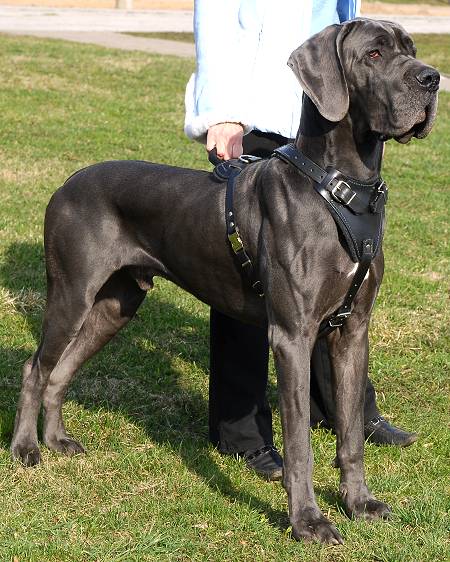
The Great Dane is a giant dog that combines nobility with robustness and power with elegance. It has a long narrow head with an accentuated frontal stop and a rather large nasal canal. Its neck is long and muscular and its front legs are perfectly straight. It has muscular thighs and round feet with short, dark nails. The Great Dane's tail is medium-length, reaching to the point of the hock. Its eyes are round and usually dark - with a lively intelligent expression. Its ears are either cropped rather long, pointed, and carried erect, or left natural. Its well developed white teeth must close in a scissors bite. All Danes have short, thick, shiny, close-fitting hair. The color of the coat indicates the variety, fawn, brindle, black, blue, mantle harlequin and sometimes merle. Although not a recognized color, chocolate does occur in a recessive gene. Merle is a common result of harlequin breeding, but it is not a recognized color. Black coats and dark eyes, while blue Danes may have lighter eyes.
Temperament :
The Great Dane is a gentle giant. Dignified, kind, sweet and affectionate, it is playful and patient with children. It loves everyone and needs to be around people. The Great Dane does not bark much and only becomes aggressive when the circumstances require it. A steady dog, responsible and dependable. Brave and loyal, it is a good watchdog. Because of his giant size, the Great Dane should be thoroughly obedience trained when young so it will be manageable when fully grown. Teach this giant dog not to lean against people, especially children. The objective in training this dog is to achieve a pack leader status. It is a natural instinct for a dog to have an order in their pack. When we humans live with dogs, we become their pack. The entire pack cooperates under a single leader. Lines are clearly defined. You and all other humans MUST be higher up in the order than the dog. That is the only way your relationship can be a success. Dogs who know their place below humans in the pack order will be good with children. If you are not a firm, confident, consistent pack leader who knows how to correct the dog when he is showing signs of aggression, the dog can be dog-aggressive, especially with same sex dogs.
Height :
Dogs 30-34 inches (76-86 cm.) Bitches 28-32 inches (71-81 cm.)
Weight :
Dogs 120-200 pounds (54-90 kg.) Bitches 100-130 pounds (45-59 kg.)
Dogs of even larger size are more prized.
Health problems :
Not a long lived breed. Be careful to buy from a conscientious breeder, as some very poor specimens are being sold to the unsuspecting public. Beware of hip dysplasia; buy only from OFA certified stock. Also prone to bloat, tumors, heart disease, and tail injuries. Do not jog with this dog until it is at least one year old.
Living condition :
The Great Dane will do okay in an apartment if it is sufficiently exercised. It is relatively inactive indoors and does best with at least a large yard.
Exercises :
The Great Dane needs plenty of exercise. They need to be taken on a daily long walk.
Life expectancy :
The average is under 10 years, however some can live to be 12-13 years old.
Grooming :
The smooth short-haired coat is easy to groom. Comb and brush with a firm bristle brush and dry shampoo when necessary. Bathing this giant is a major chore, so it pays to avoid the need by daily grooming. The nails must be kept trimmed. This breed is an average shedder.
Origin :
Incised on some Greek money dating back to 36 B.C. is the image of a dog very similar to the Great Dane of today. The Great Dane is known as the "Apollo of all dogs." In 407 A.D. German Gaul and part of Italy and Spain were invaded by an Asiatic people (the Alans) who brought with them powerful mastiff-like dogs. In Germany especially, where these magnificent animals capable of overcoming bears and wild boars were much admired, a process of selective breeding was begun. The dogs were crossed with Irish Greyhounds, and the issue was the beautiful, large, thin, agile dog known today as the Great Dane. Despite the fact that they are called Danes in English, these dogs have nothing to do with Denmark. Some of the Great Dane's talents are tracking, watchdog and carting.
Tuesday, January 13, 2009
The Standard Poodle
The Standard Poodle is an elegant, medium to large-sized dog, with a profuse, but well groomed and clipped, wiry curly coat. The head and muzzle are long. The skull is a bit rounded, with a slight stop. The teeth should form a scissors bite. The ears are wide and hanging close to the head. The eyes are oval and generally very dark. Brown and cafe-au-lait colored Poodles have dark amber eyes, while apricot dogs may have amber eyes, but dark eyes are considered better. The Poodles length from breastbone to rump is approximately the same as the height at the withers. The topline is level except for a slight depression behind the withers. The croup is rounded and the feet are compact, small, and oval. The tail is docked to half the original length. All solid colors are allowed. The coat may be groomed into three basic styles: the "pet clip" (or puppy clip), with relatively short hair all over the entire body, the "English saddle clip," and the "Continental clip," with the rear half of the body shaved, bracelets left around the ankles, and pom-poms left on the tail and hips. The Standard Poodle has a delightful springy gait.
Temperament :
The Standard Poodle is proud, elegant, dignified and good-natured. These dogs are highly intelligent and one of the most trainable breeds. They are pleasant, happy and sensitive. The Standard Poodle tends to be a bit calmer than the smaller variety of Poodles, but will become high strung if you do not give them the proper amount and type of exercise. They need to be with people and dislike being alone. They are generally friendly toward strangers, and are excellent with children. The Standard Poodle is good with other dogs. Some Standards are good guard dogs and some can be trained as hunters. Make sure you are this dog's firm, consistent, confident pack leader, providing daily pack walks to avoid separation anxiety and other unwanted behavior issues.
Height :
15 (38cm) or more
Weight :
Dogs 45-70 pounds (20-32kg.) Bitches 45-60 pounds (20-27kg.)
Health problems :
A long-lived breed, Poodles are, nevertheless, subject to many genetic diseases. Cataracts and progressive retinal atrophy may cause blindness, allergies and skin conditions are common... possibly due to unskilled use of clippers or allergies to shampoo and/or color reinforcer. Hip dysplasia, runny eyes, and ear infections are also common. They are prone to Von Willebrand's Disease. Brown Poodles tend to become prematurely gray. Prone to bloat, so it is wise to feed your Standard 2-3 small meals a day, rather then one large one.
Living condition :
If given enough exercise, Standard Poodles are relatively inactive indoors. They will be okay in an apartment if they are sufficiently exercised. A small yard will suffice.
Exercise :
The Standard Poodle needs to be taken on a daily walk. Although they adore water and love to go for walks, Poodles are not demanding as far as exercise goes, so long as they get their walk in. They however, will keep in better spirits and be fitter if given regular opportunities to run and play off the leash in a safe area. The Standard retains its sporting instincts, has great stamina, and needs more activity than the smaller varieties.
Life expectancy :
About 12-15 or more years.
Grooming :
Extensive grooming is needed. They must be bathed regularly and clipped every six to eight weeks. The ears should be checked regularly for mites and the ear hair should be pulled out if necessary. The traditional clips were developed to lighten the weight of the coat for swimming while protecting the joints and major organs from cold, but many owners opt for the plain lamb clip - the same length all over, because it is easier and more economical to maintain. The teeth need regular scaling. Poodles shed little to no hair and are good for allergy sufferers. (See description for different styles of clips.)
Origin :
Although the Poodle has been known throughout Western Europe for at least 400 years, its origin is controversial. Whether it was developed in France, Germany, Denmark, or the ancient Piedmont, is uncertain. Despite the claims of several other countries, France has now been officially recognized as its country of origin, and the breed occupies a special place on the affections of the French. It is certain that the Poodle is descended from a now nearly extinct French water dog, the Barbet and possibly the Hungarian Water Hound. The name "Poodle" probably derives from the German word "Pudel," which means one who plays in water. The Poodle was used as a gun dog. Originally the breed was used in Germany and France as a retriever of waterfowl. Hunters clipped the dog's thick coat to help him swim, leaving hair on the leg joints to protect them from extreme cold and sharp reeds. The French capitalized on the breeds high intelligence, trainability and innate showmanship and made the Poodle into a circus performer. His great popularity in that country led to the breeds common name "French Poodle." In France, however, the Poodle is called the "Caniche," or duck dog. The Poodle has been used to sniff out truffles lying underground in the woods. Poodles are depicted in 15th century paintings and in bas-reliefs from the 1st century. Toy Poodles became royal favorites, particularly in the 18th century. The Toy and Miniature Poodles varieties were bred down from larger dogs, today known as Standard Poodles. The three sizes are considered as one breed and are judged by the same standard. Today, the Poodle is primarily a companion and show dog, though he can learn almost anything.
Monday, January 12, 2009
Golden Retriever
The Golden Retriever is a beautiful, sturdy, well-proportioned dog with a feathered, medium-length, cream to golden-colored coat. (The coat is not suppose to be red.) The outer coat is water-repellent and the undercoat is dense. The head is broad, with a tapering, but wide, powerful muzzle. It has a scissors bite and a clear frontal stop. The nose is black and the kindly eyes are brown with dark rims. The ears are medium-sized and pendant. Its neck and thighs are muscular and the chest is broad. The tail is long, but never curled.
Temperament :
These are lovable, well-mannered, intelligent dogs with a great charm. They are easily trained, and always patient and gentle with children. Loyal, confident, sweet and eager to please. It is active, loving and an outstanding family dog. Golden Retrievers enjoy pleasing their masters, so obedience training can be fun. They excel in obedience competitions. Friendly with everyone, including other dogs, the Golden Retriever has very little, if any, guarding instincts. While unlikely to attack, Goldens make good watchdogs, loudly signaling a stranger's approach. This breed needs to be around people who display leadership to be happy. The Golden Retriever may become mischievous and/or high-strung, over-exuberant and distractible if he is lacking in daily mental and physical exercise. Be sure to remain this dogs firm, but calm, confident, consistent pack leader to avoid behavioral issues. Some of the Golden's talents are hunting, tracking, retrieving, narcotics detection, agility, competitive obedience, and performing tricks. These dogs also love to swim.
Height :
Dogs 22-24 inches (56-61cm.) Bitches 20-22 inches (51-56cm.)
Weight :
Dogs 60-80 pounds (27-36kg.) Bitches 55-70 pounds (25-32kg.)
Health problems :
Prone to hip dysplasia and congenital eye defects. OFA and CERF certification are important from both parents. Parents should also be checked for Von Willebrand's disease and heart problems. Skin allergies are common in Golden Retrievers and require immediate veterinary attention.
Living condition :
This breed will do okay in an apartment if sufficiently exercised. They are moderately active indoors and will do best with at least a medium to large yard.
Exercises :
The Golden Retriever needs to be taken on a daily, brisk, long walk, jog or run alongside you when you bicycle. In addition, they like to retrieve balls and other toys. Be sure to exercise this dog well and do not overfeed, as he tends to put on weight.
Life expectancy :
About 10-12 years
Grooming :
The smooth, medium-haired double coat is easy to groom. Comb and brush with a firm bristle brush, paying particular attention to the dense undercoat. Dry shampoo regularly, but bathe only when necessary. This breed is an average shedder.
Origin :
The Golden Retriever was first developed in the British Isles, probably from crosses between a yellow Flat-Coated Retriever, light-coated Tweed Water Spaniels, other spaniels, setters and even the Newfoundland and possibly the Bloodhound. In fact the breed was first shown as a Golden Flat-Coat. The Golden is one of the world's foremost family companion dogs. Many of the top obedience competition dogs in the country are Golden retrievers. The Golden is also a fine bird dog on both land and in the water. He has an excellent nose and has been used not only for hunting and tracking, but also for narcotics detection. Because of his great desire to please and capacity for love and learning, the Golden Retriever is also used as a guide for the blind, therapy dog, and service dog for the disabled.
Pug Information and Description
The Pug has a square, thickset, stocky compact, body, with a sleek, soft coat that comes in apricot, fawn, black and silver - all with a short, flat, black muzzle and velvety ears. Rose shaped ears are preferred. Moles on the cheeks are considered beauty spots. The eyes are prominent, expressive, dark and lustrous. The teeth should meet in a slightly undershot bite. The back is short, with a level topline. Their tail lays in a tight curl, or in the best specimens, a double curl on the back. Their limbs are straight and strong which gives them a jaunty, rolling gait that is quite distinctive.
A Pug is "a lot of dog in a small space." They are perky, rambunctious and loyal, affectionate and loving, with a happy disposition. They are playful and charming. Clever and mischievous - with a heart-winning personality. They can be a bit willful. Highly intelligent, it bores easily with repetitive training practices. Pugs are sensitive to the tone of your voice, so harsh punishment is unnecessary. The dog is neither excitable nor dull. They are good watchdogs, very devoted and are not yappers. Pugs get along well with other dogs and pets, and they behave impeccably with both children and visitors. Be sure to be your Pug's pack leader. Pugs who do not have strong human leaders can become jealous, and begin to display guarding behaviors, such as guarding furniture, food, toys, or other spots in the house. This behavior only happens when dogs are allowed to take over. These behaviors can be corrected when the owners start displaying the proper leadership. Dogs who feel they need to run the home are not as happy as dogs who know they are human followers, as it is very stressful for a dog to need to keep "his" humans in line.
Height :
Dogs 12-14 inches (30-36 cm.) Bitches 10-12 inches (25-30 cm.)
Weight :
Dogs 13-20 pounds (6-9kg.) Bitches 13-18 pounds (6-8kg.)
Health problems :
Pugs catch colds easily and are stressed by hot and cold weather. They are prone to allergies and the short muzzle contributes to chronic breathing problems. (Pugs suffer from poor ventilation.) They are not the easiest whelpers. Expect Cesarean Section if breeding. There is a chance of keratites (inflammation of the cornea) and ulcers on the cornea. The delicate eyes are prone to weeping. This breed tends to wheeze and snore, but on the whole is a very easy-care dog. Do not overfeed a Pug, as they will eat more than is good for them, quickly becoming obese and living much shorter lives. Prone to skin problems. Pone to Pug Dog Encephalitis (PDE), an inflammation of the brain that strikes adolescent Pugs usually between the ages of 2 and 3. The cause is unknown.
Living condition :
The Pug is good for apartment life. It is relatively inactive indoors and will do okay without a yard. Cannot withstand hot or cold weather and should be kept indoors at a comfortable temperature.
Exercises :
Pugs are strong dogs with short straight legs. They need to be taken on daily walks. They enjoy energetic games and will keep in better health if given regular exercise. But be careful not to over do it, especially if you see them start to wheeze.
Life Expectancy :
About 12 to 15 years.
Grooming :
The smooth, short-haired coat is easy to groom. Brush and comb with a firm bristle brush and shampoo only when necessary. After bathing, dry him quickly and thoroughly to prevent chill. The creases on the face must be cleaned regularly. This breed is a seasonally heavy shedder.
Origin :
One of the older breeds, the Pug is believed to have originated before 400 BC in Asia. There is somewhat of a debate over the origin of the Pug. Some experts think it came from the Lowlands, brought back from the Far East by Dutch traders. It is possibly of Oriental stock, descended from a short-haired Pekingese, but another theory is, it is the result of crossing a small Bulldog. Yet another school of thought is that it is a miniature form of the rare French Mastiff called Dogue de Bordeaux. Pugs were a favorite of the artist Hogarth, who included his pet Pug "Trump" in several of his works. From the sixteenth century, it became a fashionable adornment of the European Courts, reaching its peak of popularity in Victorian times. He was a pet at Tibetan monasteries and later traveled to Japan. The Pug then came to Europe, where the endearing little dog was the pet of royalty in several countries and even became the official dog of the House of Orange in Holland. A Pug saved William, Prince of Orange's life by alerting him to the approaching Spaniards in 1572 at Hermingny. Napoleon's wife, Josephine, sent secret messages to her husband under the collar of her Pug while she was in prison. When the British overran the Chinese Imperial Palace in 1860, they discovered several Pugs and Pekinese, and brought the little dogs back to England with them. The AKC recognized the Pug in 1885 and the breed has since become a popular companion dog. Some of the Pug's talents include: watchdogging and performing tricks.