Showing posts with label Chihuahua. Show all posts
Saturday, October 20, 2012
Pet Boots and Shoes
Why dogs need pet boots and shoes
In the winter time, especially in snowy areas, cities often put down chemical de-icers as well as salt on pavement. If you walk your dog on this pavement, his paws will become covered with this salt and chemicals. This causes problems for many dogs. Their paws can chafe and crack. You can use emollients on their paws to help them heal.
You can also use paw wax to help toughen the paws. And you need to wash your dog's paws when he walks on pavements where these chemicals are found. Do not let your dog lick his paws after he has been walking on pavement in the winter until they have been washed. These chemicals can be dangerous for your dog. You can also put pet boots or shoes on your dog when you walk him so you can keep his paws free of these chemicals. Boots and shoes will keep the salt and chemicals off your dog's paws so they won't crack and they will prevent your dog from ingesting the chemicals.
In the summer, dogs who walk on hot pavement can appreciate wearing boots or shoes to keep their paws from getting too hot. Rain boots can also be a good idea if you want to keep your dog's paws dry.
Senior dogs with arthritis or other mobility problems can often have trouble walking because they can't get enough traction on the floor. This is especially true if you have hardwood floors. If you put pet boots or shoes on your dog's paws, especially on his rear paws, it will often provide the traction he needs so he can walk again.
Some hunting dogs wear boots or shoes if they will be hunting in tough terrain that could injure their paws. Of course, there are many boots and shoes that are made for fashion reasons. You can always buy them for your dog just because they look good.
Choosing boots and shoes
Pet boots and shoes usually come in small, medium, and large sizes. You should choose the size that's appropriate for your dog. Some boots and shoes have Gore-tex or other gripping soles. These boots and shoes would be especially good for dogs that need good traction.
There are several good brands of dog boots and shoes. You can find them online or in pet stores. Brands include Guardian Gear, UltraPaws, and Muttluks. Some dog boots and shoes come in four-packs and some come in two-packs. Boots and shoes tend to be rather expensive but they do last a while.
Your dog may have trouble walking in the boots or shoes at first or try to remove them but most dogs quickly adjust to them. Elderly dogs should adapt and become more mobile as soon as they realize they can get their footing again.
Thursday, March 12, 2009
A Look at Chihuahua Mixes - A Great Companion Dog
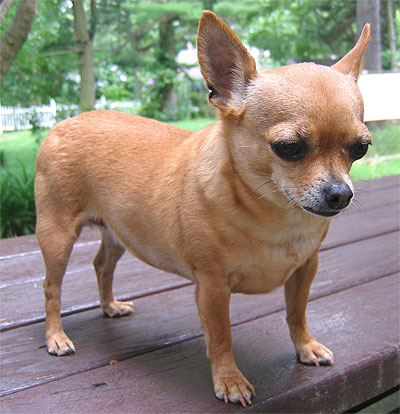
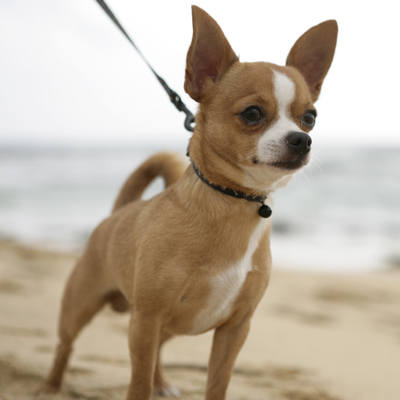
Chihuahuas are a very popular breed of dog despite their annoying yipping! They're extremely tiny (the smallest in the world, actually) and cute (some would say) as well as having an amusing personality in which they don't seems to realize how much smaller they are than... everything else. Their attempt to intimidate and impose their will on others is amusing, adding to the likability of this animal. It's for these reasons that Chihuahuas are one of the top 10 most popular dog breeds in America. Another popular idea in modern times are Chihuahua mixes-dogs created by breeding pure-bred Chihuahuas with pure-breds of another breed. These new animals can vary in size and colour depending on what the other parent breed is, and often combine the traits of the two animals both in physical appearances, as well as personality traits.
Some of the breeds that are popularly bred with Chihuahuas to make desirable mixes are Terriers, Pomeranians, and Poodles. Each of these combine the parent breeds in unique ways from one another.
Pomeranian Chihuahua mixes almost perfectly combine the appearances of Chihuahuas, and Pomeranians. They tend to have a Pomeranian's long and fine hair, a body that seems like a natural combination of a Pomeranian and Chihuahua, while maintaining the Chihuahua's unique facial structure.. Interestingly enough, they have personality traits, which are uncharacteristic of each parent breed, making them their own unique animal. They should be well groomed on a regular basis to maintain their look, as their hair is quite long and easily matted.
After the advent of the Taco Bell dog in the mid-90's, Taco Terriers became popular in the United States. They're a combination of a Chihuahua and a Toy Fox Terrier, and are just one of many Chihuahua-Terrier cross breeds.
Poodles are also often bred with Chihuahuas to create an interesting animal which combines various traits in a unique (although not very attractive) way. While they're bred often, they are not altogether popular and can often be found as strays on the streets or in rescue shelters.
Another common combination, although more for financial gain than of the breeder than the choice of the buyer, is a cross between a Chihuahua and a Miniature Pinsher. This results in a dog that looks like a pure-bred Chihuahua when it is very young, but as it gets older it quickly becomes evident that it's not as it gets much larger than a Chihuahua and with slightly different facial features.
Some of the breeds that are popularly bred with Chihuahuas to make desirable mixes are Terriers, Pomeranians, and Poodles. Each of these combine the parent breeds in unique ways from one another.
Pomeranian Chihuahua mixes almost perfectly combine the appearances of Chihuahuas, and Pomeranians. They tend to have a Pomeranian's long and fine hair, a body that seems like a natural combination of a Pomeranian and Chihuahua, while maintaining the Chihuahua's unique facial structure.. Interestingly enough, they have personality traits, which are uncharacteristic of each parent breed, making them their own unique animal. They should be well groomed on a regular basis to maintain their look, as their hair is quite long and easily matted.
After the advent of the Taco Bell dog in the mid-90's, Taco Terriers became popular in the United States. They're a combination of a Chihuahua and a Toy Fox Terrier, and are just one of many Chihuahua-Terrier cross breeds.
Poodles are also often bred with Chihuahuas to create an interesting animal which combines various traits in a unique (although not very attractive) way. While they're bred often, they are not altogether popular and can often be found as strays on the streets or in rescue shelters.
Another common combination, although more for financial gain than of the breeder than the choice of the buyer, is a cross between a Chihuahua and a Miniature Pinsher. This results in a dog that looks like a pure-bred Chihuahua when it is very young, but as it gets older it quickly becomes evident that it's not as it gets much larger than a Chihuahua and with slightly different facial features.
Sunday, February 15, 2009
Stop the Mess When Housebreaking a Chihuahua Puppy
Housebreaking a Chihuahua puppy can be quite a challenge. Chihuahuas are famous for being difficult to house train at times. You see, just the small size of your puppy makes a difference. Very small dogs often can feel frightened and vulnerable. That's a main reason your puppy may not even like to go outside. Here's what you can do...
1. Wait.
Don't start too soon. Make sure your puppy is capable of controlling elimination before you try. Otherwise you're set up for frustration. Often about 12 weeks is the right age. Check with the breeder.
2. Remember... gentle.
Praise success. Punishing a puppy for accidents may be very confusing and can lead to aggressive behavior. Be careful how you react to problems.
1. Wait.
Don't start too soon. Make sure your puppy is capable of controlling elimination before you try. Otherwise you're set up for frustration. Often about 12 weeks is the right age. Check with the breeder.
2. Remember... gentle.
Praise success. Punishing a puppy for accidents may be very confusing and can lead to aggressive behavior. Be careful how you react to problems.
3. Habits are useful.
Puppies eliminate shortly after eating and drinking. Just watch for signs and you can be ready to whisk your pup to the right spot. The other time to be on the lookout is after naps.
4. Think paper.
Use papers as the elimination spot if you can't make it outside. After the papers become the spot to go, start moving the papers outside or wherever you choose.
5. The nest method.
Puppies don't like to foul their nests. You can confine your puppy in a nest for short periods of time. That nest might be in a crate. Your part is to watch very closely for signs of elimination. At those signs, out goes the puppy. Do your part. You must monitor the puppy all the time the pup's in the nest.
Wait until your puppy is old enough before you start puppy training. Then use just a few little tricks. With patience and time, your puppy should learn what's expected and your problems are over.
Subscribe to:
Posts (Atom)